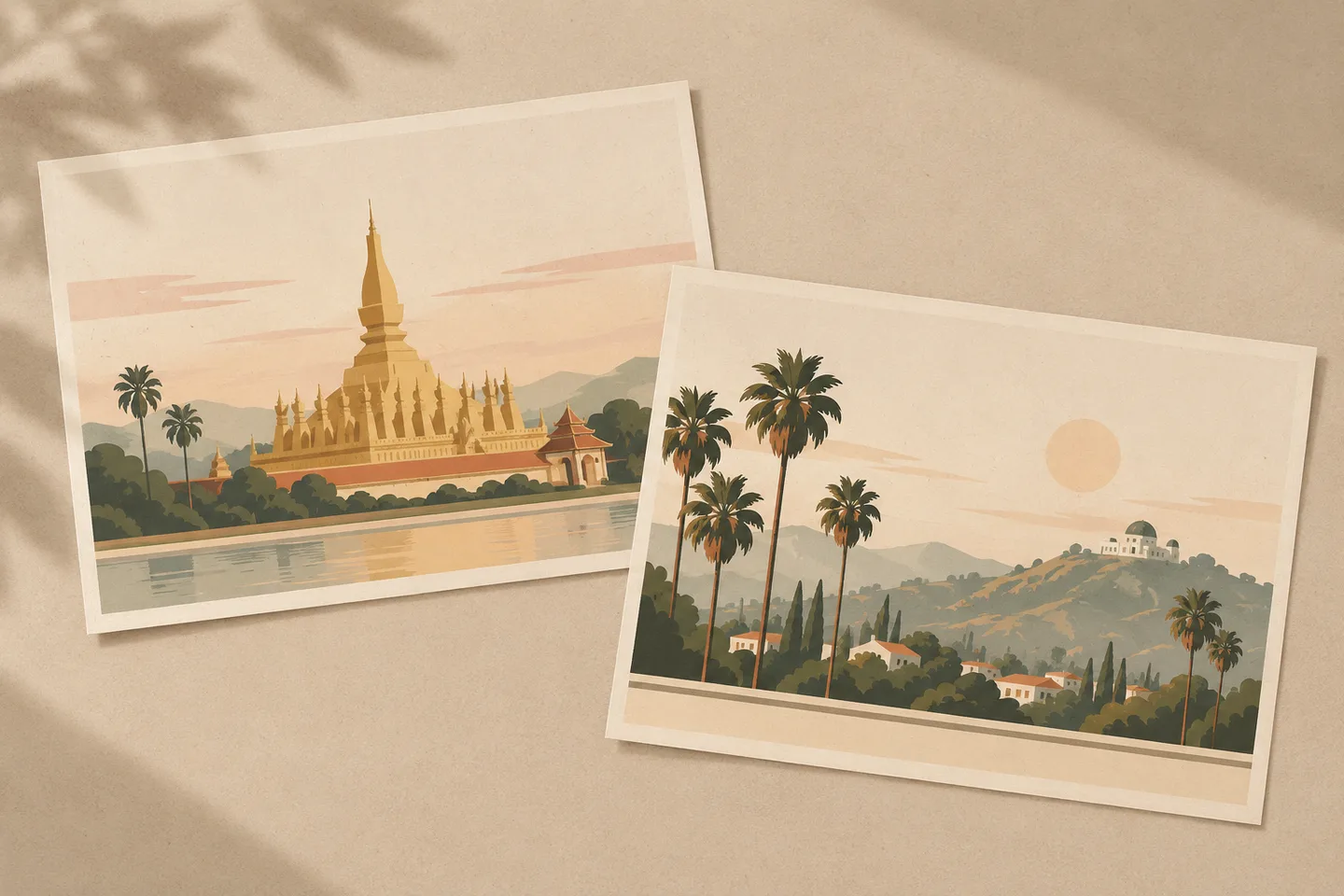
Our tiki bar's web address is swizzle.la. When I tell people this, the Lao ones nod, because of course: la, Laos. The foreigners pause, and then one of them says: "Wait. Los Angeles?"
Both are right, and the reason both are right is one of the odder small stories of the internet.
1996: every country gets two letters
In the early days of the web, each country was handed a two-letter ending for its addresses, taken from the international list of country codes. Germany got .de, Thailand .th, Vietnam .vn. On 14 May 1996, Laos got .la.
Most countries treated their two letters as national property: you had to be a local company, or at least prove a connection, to register one. Laos, in 1996, had a handful of internet users and bigger things to think about. The domain existed, but almost nobody wanted it. For a few years, .la was a shelf with nothing on it.
The Los Angeles idea
Then somebody noticed what the two letters spelled.
A Hong Kong company, Sterling Holdings, bought the right to sell .la addresses and pointed them at a completely different market: Los Angeles, and for good measure, Louisiana. From 20 November 2000, anyone anywhere in the world could register a .la name, no Lao connection required. From 2001 it was marketed to Angelenos as the city's own ending, a bit like a local area code for the web. The rights now sit with a company called LA Names, registered in Guernsey, and the technical side has been run from London since 2007 by CentralNic, a firm that operates dozens of these endings.
It worked, modestly. There are Los Angeles restaurants, radio stations and design studios with .la addresses that have never heard of Vientiane. In 2013 GoDaddy, the big American registrar, ran a fresh campaign selling .la as the Los Angeles domain and interest rose again. On the Lao side, the national internet centre, LANIC, under the Ministry of Technology and Communications, still formally holds the domain; it was re-delegated to the Lao government in 2002, and the worldwide marketing happens with its blessing. So the dual identity isn't a hack or a mistake. It's the arrangement.
The other accidental owners
Once a country ending is open to the world, the world gets creative, and .la turned out to be unusually useful to people with no interest in either Laos or Los Angeles.
- Short links. Mozilla, the Firefox people, shortens its links to mzl.la. Tesla uses ts.la. Two letters at the end are gold when you're counting characters.
- "There". In French and Italian, là means "there", so a whole genre of wordplay addresses exists: go.la, click.la, that sort of thing.
- A made-up language. Toki Pona, a tiny constructed language with a few thousand speakers, uses the word la as a grammatical marker. Its community has adopted .la as its unofficial home. Several of the main Toki Pona websites end in Laos's country code.
- Latin America. In Spanish-speaking countries "LA" is a common shorthand for the region, which brought another wave of registrations with no connection to either city or country.
- The first emoji domain. On 13 April 2011, a software designer in Portland named Cabel Sasser registered a .la address that was just the poop emoji, and announced it as the world's first emoji domain. It was a joke. It was also, technically, a Lao web address.
I find this delightful. A country of eight million people, which most of the world can't place on a map, is quietly present in the address bar of a Firefox user in Berlin and a Tesla owner in Texas.
The numbers, and why they matter to you
Here's the part that's useful rather than charming. At its peak, in March 2021, .la had around 175,000 registered names. By 2024 that had fallen to under 50,000. Fashions in domains move on; the Los Angeles idea never became the next .com, and a lot of speculative registrations were allowed to lapse.
For a Lao business that's good news. The short, obvious names that would have been taken in a popular ending are often free in .la. swizzle.la was available. Try the same word in .com and you'll usually find a parked page asking for four figures.
The practical facts, as of this year:
- Anyone can register a .la name. You don't need to be in Laos, or Los Angeles, or anywhere.
- It costs roughly $25 to $45 a year depending on the registrar, with the cheaper ones around the lower end. Renewals are similar. That's more than a .com, less than most "fancy" endings.
- Names can be 3 to 63 characters, and the normal privacy and security options apply.
- Since 2019 there is also a Lao-script ending, .ລາວ, approved for addresses written entirely in Lao. It's barely used so far, but it exists.
The flip side of "anyone can register one" is that anyone can register yours. If your café is called Mango House and you've been meaning to get mangohouse.la, a bar in Silver Lake can take it first, legitimately, and you have no special claim because you happen to be in Laos. The domain is open to the world; the world includes California.
So: .la or .com?
When we build a website for a Lao business, this comes up every time. My honest answer:
- Take .com if it's available and affordable. It's the ending everyone's thumb types by habit, and it's what a hotel chain or a foreign supplier expects to see on an invoice.
- Take .la when the .com is gone, or when the name is the brand. For a bar, a café, a creative studio, a restaurant that lives on word of mouth, .la reads as local, short and a little bit clever. Lao customers get it instantly. Foreign visitors get a story to tell.
- Take both if you can. Point one at the other. It costs one extra renewal a year and closes the door on the Silver Lake bar.
- Skip .ລາວ for now unless your whole audience types in Lao script and never shares links abroad. Most phones and most people still expect Latin letters in an address.
Why we chose it anyway
We could have had a longer .com for the bar. We chose swizzle.la because it's the name of a drink and the name of a place in seven letters, because it says Laos to everyone who lives here, and because, if I'm honest, I like that somebody in Los Angeles will one day type it expecting a cocktail bar on Sunset and find one near That Luang instead.
Two letters. One small country. A city on the other side of the Pacific that borrowed them and never gave them back. That's the internet: nobody planned it, and it mostly works.
Laos got two letters in 1996. Los Angeles has been borrowing them ever since.